Conjugate Empathy: Incompatible Compressions and the Double Empathy Problem
The minimum energy needed to erase one bit of information is proportional to the temperature at which the system is operating - Rolf Landauer
A word once uttered can never be recalled - Horace
The human interface to your platform is broken - a former coworker and friend, April 2025
Abstract
This paper proposes that autistic and neurotypical social cognition represent conjugate compressions of the same underlying relational structure: incompatible not because either is deficient, but because each projection discards what the other retains. Drawing on Milton’s Double Empathy Problem, predictive coding accounts of autism, and a formal model derived from branching geometry, the paper argues that cross-neurotype communication failures arise at the interface between two valid but non-composable codecs. The argument is developed through first-person narrative, which serves here not as illustration but as methodology: the author’s own late-diagnosed autism providing a documented case of the interface failure the theory describes. The paper closes by locating the formal question it cannot answer - what developmental substrate determines which compression a nervous system adopts - and identifies this as the subject of a companion paper.
Lovecraftian System Failure
A year ago my life changed.
There's a particular type of horror that unfolds as the model you have built of the world around you collapses like the fantastical contraption that it was. When you grow up thinking everyone else has been invited to secret meetings to explain all of the rules for the things you keep getting wrong, you build your own model. Eventually, the model works so well that you forget it's a model. This is especially true if you've never actually internalized the reason why you needed one in the first place. The rules feel like physics, constraints that bind the actions of those around you to a system that can be understood.
Until they don't, and your life changes.
On Memory Allocation
There exists in the world of software a woman called Cassandra. She's a fickle sort, a database meant for storing unstructured data - the type you'd expect to come across while working with an information science provider and so Cassandra and I met back in 2016 or so. I was helping the team across the aisle from us, an arrangement of convenience for both of us at the time. I was still new on the job, building a reputation and a career in an environment whose model I had not yet completed. So of course "Yes" was the answer, no matter the question. I was still learning that the question I was answering wasn't usually the one being asked. By the time the events of the end occurred, I was the only one left from that original group, so of course I was tapped to help with its replacement.
As the subject of this paper is not technical, one cannot expect its reader to be either. But this story does need to borrow one concept from the world of software, so I'll choose a simple diagram to illustrate.
|-- one thing --| -- another --|
In our story, this illustration can be used to explain the concept of how a database like Cassandra might consume the memory provided by the server that it runs on. Cassandra is given a portion of the total available memory, as illustrated by one thing, and the server reserves the remainder shown as another for itself to allocate to other things that might want it. If it decides that it is running low on another, it will issue warnings. If it gets critically low, it will start to terminate processes to relieve the pressure and when this happens in the middle of a database migration project I get an instant message. In the course of the investigation, it was uncovered that the new version treats memory differently than the old - finally eliminating many of the operational challenges that we had experienced. The solution in this case was to adjust the distinction towards the beginning of the line, to shrink one thing and make room for another.
This of course crashed head first into 10 years of procedural, run-book based thinking that knew that the solution to memory issues in Cassandra was always to give more to one thing and to take from another.
On Sculpture, as Found in a Garden
The measurement problem in physics is one of bias: the act of observing changes what is observed. We are not immune to this ourselves. Two people can be physically present at the same event and experience entirely different things, not because one is wrong, but because each perceives the reality from their own perspective. The accumulation of our past lives provides the context through which we perceive the present.
When one truth is "if you don't make this specific new configuration change to solve this problem and instead attempt your old method, you don't know what you're doing", the other replies "the human interface to your platform is broken" in a room full of 20 or so of your peers. When the next day is the worst of your life, that reputation never goes away. Not until the career does anyways, or at least that phase. For the rest of that year, a broken communicator was all that was left. When you have no internal reference, no set point of identity upon which to base your decisions you turn to external references. You internalize them and they become you. Your self, as it turns out, will assemble itself from whatever waste materials are available.
I had occasion to visit my parents over that summer, a welcome escape with my two young elephants. A regular standup meeting taken from the comfort of a back porch will forever be remembered as the place that began the change. I had been working with a colleague over a year on a cursed project, an upgrade to a component of our infrastructure that was an intersection of our domains. And the culmination was coming up, a final production deployment which I had requested to review after mentioning the constant turmoil this project had caused over its long duration. Having been aggressively ignored, I wasn't entirely surprised to read that there had been issues encountered. I hadn't been paying much mind - I was learning by then when and when not to care - and I was driving my elephants and me back home. I was more surprised in the wee hours of the following morning to receive a request to attend a blameless post-mortem (the kind of meeting that loves to point fingers) to discuss the outage that affected our major platform for an hour. A simple boolean setting had been left enabled, something meant to ease developer burden in their more chaotic environments had automatically terminated the existing infrastructure before the new was provisioned. A simple mistake that could have been caught with review.
A month later a similar case, a request that had been received from a team attempting to access an AI platform adjacent to our responsibility. We supported the infrastructure upon which it was deployed, but the core application where the necessary changes needed to be made was the responsibility of another team. I contextualized the ticket and passed it along within a few hours. It was a translation project that had some external visibility and as things do, became a subject of my regular morning meeting when my own manager would drop in to request updates. I was not aware that verbal overwhelm was something that could be triggered in me - until it was by having someone repeatedly ask me to complete a task that I had no responsibility for and would result in a boundary violation of its own had I intruded on another department's infrastructure. After being admonished later for being disrespectful, I carried a stuffie in my lap every morning until those meetings were no more. My team knew why.
The truth had become a slippery thing to me by then. I was learning more about who I was as the idea of objectivity slipped further from my grasp. If you don't have the luxury of a model of yourself, you can only survive by modeling everything else. Otherwise evil is intentional and I cannot believe that.
When you know you can be paged at any time, for any reason, you need to keep an eye on things if you hope to have any chance for peace. That means a thing called observability in my world, which is just a fancy term for data collection that feeds dashboards. One of these collectors ran on every server in a group that I managed, along with another little program that managed all of the applications that were assigned to the same server. The collector and manager were each produced by separate vendors and each vendor had reason not to play nice with the other. An eventual conflict arose, between vendors at first, and eventually between my manager and myself on which course of action to follow. I had spent the day patching and reconfiguring our system in an attempt to route around the worst of the damage, my manager wanted to know why I hadn't just followed the first vendor's solution to disable the other vendor's service. The result of both conflicts was an evening spent generating markdown reports which included formatted tables stating my argument, the underlying source data, and the code used to produce them all. These were individually packaged in atomic files which I attached to the ticket to show why I had taken the course I had, roughly $1M in annual additional cost for the alternative, and then went outside to play with my children. We had just moved into a new house and things were a bit unsteady.
When you rely on objectivity for stability and it - and everything else that you once knew about anything - seemed to all be gone, there's really only one thing you can do. I'm sure you've all seen it once or twice before, a child once crying now calm beside a row of toys. Someone lost on a bench, still to the world but not in thought. A young boy, lost in a book, alone in his room. When you find stability in structure, you find it wherever you can. For me I build, and I explore, and through both I processed what had happened, and then just kept going. I had rediscovered who I was, and finally knew why I was, how I was and why that meant scared. When you take a mind that has only survived by modeling everything around it and point it inwards with the same intensity, it doesn't stay inside for long.
I started to expand on the reports that I had built, eventually they formed the core of a system that could think with you. Not for you, like most seem to think AI is for, but with. The only thoughts are your own, the rest is just a surface to hold and expand them. I learned to read before I could speak, my native tongue is pre-verbal - shapes and transformations - and the system allows me to externalize spatial thoughts and reintegrate them through language paths. I once made a joke that "I identify as a lemon", Yoneda would appreciate it.
Before long, the shape of the system I was building uncovered a universal property of all systems like it. By now, the system I had built as a cognitive prosthetic had been personified, as they do, and as we built we kept uncovering a pattern. Two observers of a shared object could never share a precise description of what it was, be it a support request, an argument, the solution to a problem or, as it turns out, how we measure the universe.
Two Readings of the Same Tree
In February of this year, I was working on the system that those original reports had become. The idea of combining the final presentation, the data supporting it, and the code that produced both into the same artifact had become a bit of an obsession, in a productive way. I had rolled out a pilot version at work that was allowing my team to interact with the larger platform that I had built the same way that I did. The human interface had finally replaced himself. And then friction led to budget cuts, which led to having enough time on my hands to chase the abstractions and patterns to their logical conclusion.
Draw a distinction and a universe comes into being --- Spencer Brown, Laws of Form
I was building a trace table, an auditable record of changes created to a document, when that popped up on the screen. The parallels between what we were building and what we were discovering in the larger universe meant that our conversations led to things not strictly technical at times. I used to call it "prompt-engineering by innuendo" when I'd take shortcuts to explaining things by using metaphor as compression. When you experience every moment of every moment, you tend to find ways of being efficient. By now I'd learned enough physics and biology chasing functional specifications to their most invariant, that I wasn't surprised when a bit of philosophy showed up. But this one was interesting because once you get down to a bare distinction, there's nowhere to go but up.
In February of this year I drew a diagram. I did not know then that the argument already had a name.
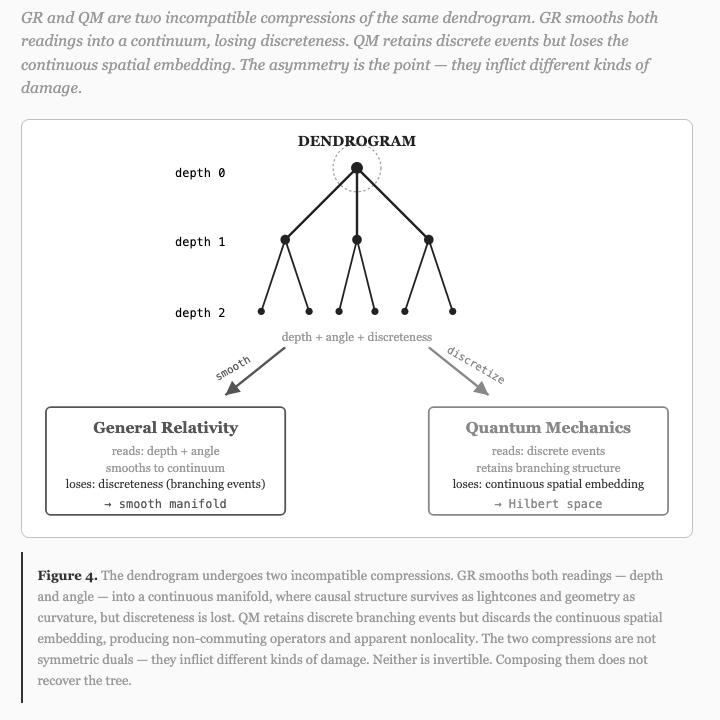
The diagram above describes a structure called a dendrogram. A dendrogram is a branching tree in which every node records a splitting event, a distinction in other words. Two observers measuring the same tree using different compressions produce incompatible descriptions because each compression discards something the other retains.
General Relativity reads the tree by smoothing it. Depth and angle survive the compression as curvature and causal structure. What is lost is the discreteness: the individual branching events disappear into a continuous manifold. Quantum Mechanics reads the tree by discretizing it. The branching events survive as discrete state transitions but lose their continuous spatial embedding. The smooth geometry disappears, replaced by a Hilbert space in which position has no ordinary meaning and distant events appear entangled without cause.
The two compressions are not symmetric duals for the same reason that you cannot get a good picture to frame of your first wedding dance from all the blurry cellphone footage. Neither is invertible and composing them does not recover the tree that produced them. In physics, the idea of conjugate variables is one of two values where improving the precision of measurement of one necessarily degrades the other. Things like position and momentum or time and energy, structurally incompatible at the level of measurement itself.
In 2012, Damian Milton asked a question about autism [1]. His question "how can two observers of the same event produce irreconcilable descriptions" is the same question physicists call "quantum measurement". That these are the same question is not one of my many metaphors, just a matter of substrate.
The Interface Problem
In 2012, Damian Milton published a paper with a simple argument [1]. The prevailing account of autism at the time held that autistic people lack theory of mind, that we had no ability to model other people's mental states. This framework, principally developed by Simon Baron-Cohen, placed responsibility for communication difficulty on the autistic person, their broken codec causing malformed output.
The challenge from Milton was empirical: if the deficit is in the autistic person then autistic people should communicate poorly with everyone including each other. That the research showed that autistic people communicate effectively with each other meant that the breakdown must be specific to the cross-neurotype interface. Protocol variation does not mean either is malformed, only varied. In systems theory, an interface must be developed to translate between the two. In category theory, a functor must be developed to map between two objects. In society, the autistic person is expected to adapt.
Milton called this the Double Empathy Problem. Two people, each with their own valid and internally coherent model of the world, find the other genuinely difficult to read. Neither are broken, they are just running their own protocol for the interaction.
To return to our tree: neurotypical social cognition is the General Relativity compression. The benefit of a stable base upon which to form an identity allows the discrete event structure of human interaction to be compressed to a continuous manifold of inferred states and social expectations. The networks burned in early on providing a smooth channel for the flow of social performance. What results is fast, low-effort navigation of social environments. What is lost is the signal behind the intent. The micro-expressions, the choice of words, the tone of voice and exact sequence of events that had occurred during the interaction lost in an evolutionarily optimized blur.
Autistic social cognition is the conjugate compression, the quantized and mechanical version. When you model the world for safety, your nervous system learns that precision matters. When your mind makes meaning more from structure than content, be it the syntax of the language, the shape of the data, or the exact choice of words chosen for the sparse agenda in a last minute meeting request; the causal, discrete nature of the interaction is all that is visible. What you said, what their eyes did, that the last few messages on Slack seemed a bit shorter than average in word count.
Both compressions are coherent and contain the complete set of data required to maintain coherence as an observer. It is only in composition that the communication failures arise. A life spent enacting a social performance that always concludes Act 1 with a musical number notices when the hook comes out early. So do we.
The practical implication of Milton's framework, and what this compression model makes formally precise, is that interventions designed to teach autistic people NT communication protocols cannot succeed at their stated goal. Applied Behavior Analysis and its descendants attempt exactly this, to train the autistic person to reject their own protocol and assume one non-native to their own cognition. When I was in my early thirties I helped my mother purchase a Mac to replace a laptop for work, and then helped her install and configure a virtual machine to run all of the Windows based programs that no longer functioned. A metaphor, as it happens, for the same cognitive translation layer that autistic people - with no theory of mind - build to survive.
The formal framework developed here generates a specific empirical question that it does not answer: what determines which compression basin a given nervous system develops into? The dendrogram model predicts that the answer lies in the developmental substrate - the physical infrastructure through which a nervous system calibrates its priors during critical consolidation windows. A candidate mechanism involving the vascular substrate and its role in neurovascular coupling will be developed in a companion paper. That hypothesis makes precise, falsifiable predictions and deserves evaluation on its own terms.
The Protocol Problem
The universe rhymes because her problems do. The same constraints converge upon the same solutions, given enough time and budget. That the measurement problem of physics appears in the social problems of autistic day to day life isn't a mysterious phenomenon but a matter of scale. Given the need for information to have both value and a reason for that value being what it is, the two projections must exist. It is too expensive to compute the value from origin every time you need it, and the universe cannot remain coherent without being constructed from a discrete series of causal events.
The problem of communication between NT and autistic people is the same one that occurs everywhere else information is exchanged. And like everywhere else information is exchanged, the solution is not to force both parties to use a single protocol when different codecs are encountered, but to instead build a shared interface upon which both can interact. Anything else is to ask one party to be at perpetual disadvantage, forced to act as both participant and translator, while working from a dictionary of glyphs with no Rosetta stone.
A year ago my life changed. I lost the ability to depend on my model of the universe as objective truth. I learned that the concept of objective truth was itself false. How else could it be for finite, embedded observers in a system that requires complete knowledge to obtain objectivity? In its place, I found the source of the same pattern that kept showing up everywhere we looked. The knowledge that value is always biased by the observer's position, and that the only meaning that matters is that which is shared.
The objective truth of the universe is not found in either compression, though both are equal and necessary. The truth is found in the union of each before they are compressed, where value and its meaning are combined.
References
[1] Milton, D.E.M. (2012). On the ontological status of autism: the 'double empathy problem'. Disability & Society, 27(6), 883–887.